01Crypto prop firmSimulated account
Crypto prop trading on BTC, ETH and SOL perpetuals.
$10,000 evaluation for $110. Reach +$800 without losing $400 in a day or $800 in total. Pass, verify your ID, and receive 80% of the simulated profit on a funded account, paid in bitcoin every 14 days.
All accounts are simulated. Payouts are rewards under the trader agreement.
Rules at a glance
| Rule | Classic 1-Step | 2-Step |
|---|---|---|
| Fee | $110 | $100 |
| Profit target | $8008% | $800 then $5008% then 5% |
| Daily loss limit | $4004% | $5005% |
| Max loss limit | $8008% static | $1,00010% static |
| Minimum trading days | 3 | 3 per phase |
| Profit split | 80% | 80% |
| Payout every | 14 days | 14 days |
02How it works
Four steps from fee to reward.
01
Trade the evaluation
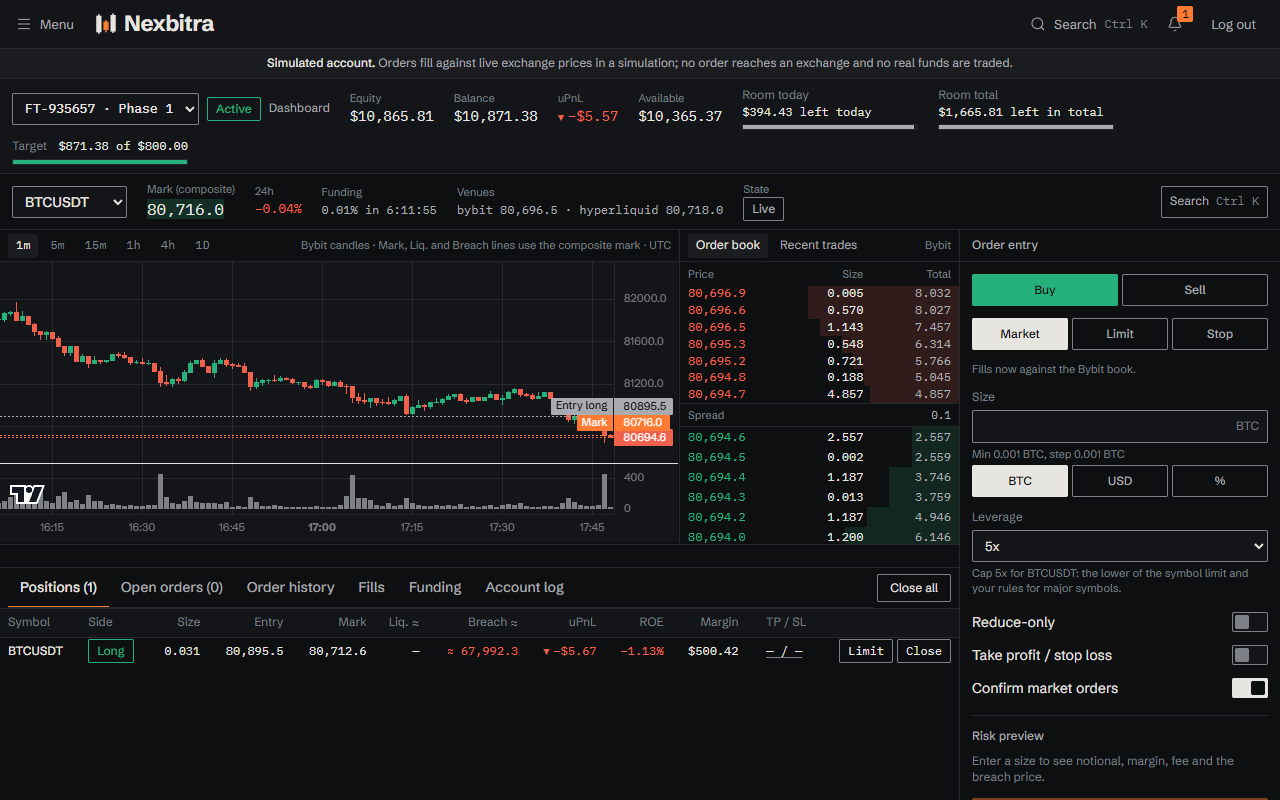
Market orders on BTC, ETH and SOL perpetuals, filled on the live Bybit order book. Reach the target without crossing either loss floor.
02
Watch the objectives
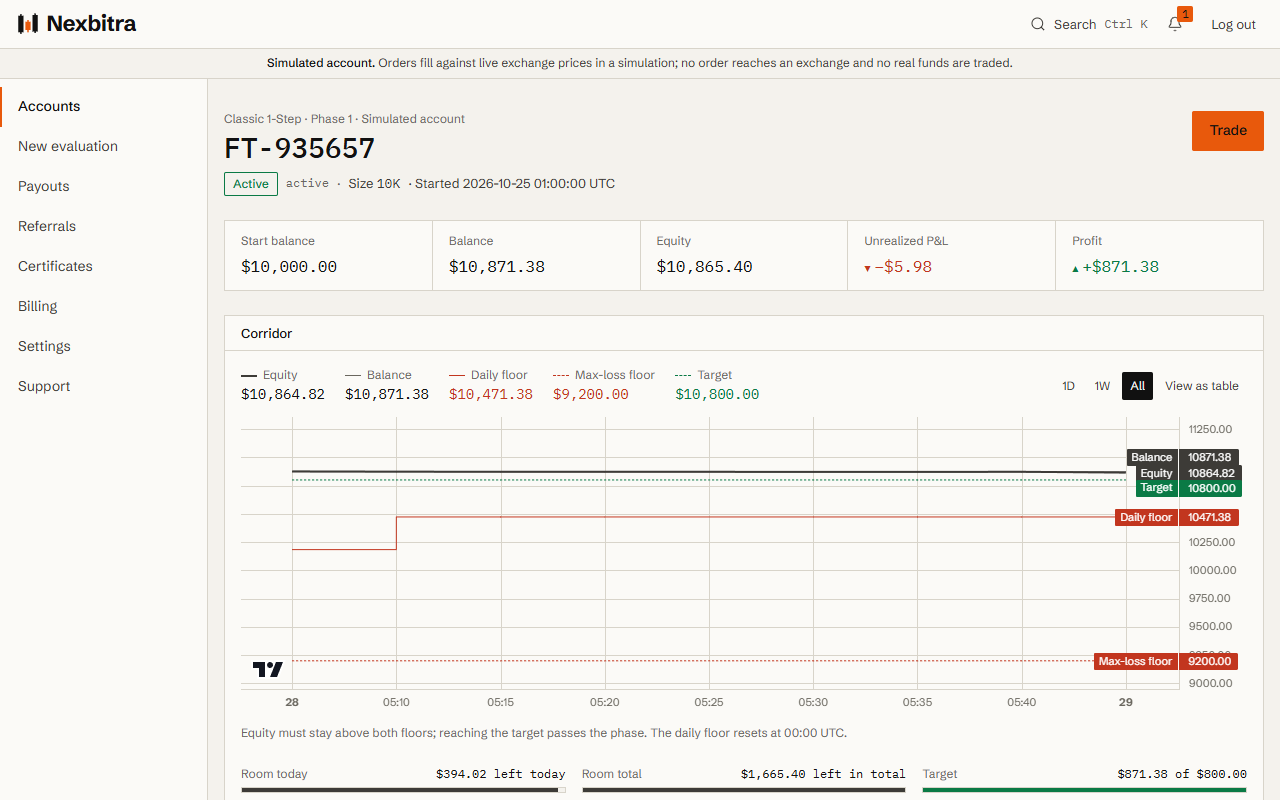
The dashboard shows profit against target, room left today and in total, and trading days counted so far (3 needed).
03
Verify and go funded
Pass, complete identity verification, sign the trader agreement, and receive a simulated funded account with the same loss limits.
04
Request a reward
Every 14 days, paid in bitcoin on-chain, with the transaction link on your payout record.
03Pricing
One fee per evaluation. No subscription.
| Account size (simulated) | Classic 1-Step | 2-Step |
|---|---|---|
| $5,000 | $60 | $50 |
| $10,000 | $110 | $100 |
| $25,000 | $280 | $250 |
| $50,000 | $500 | $400 |
| $100,000 | $800 | $700 |
| Profit target | 8% | 8% then 5% |
| Daily / max loss | 4% / 8% | 5% / 10% |
Add-ons
- 90% profit split+20% of the fee (+$22 on 10K)
Prices include every rule shown here.
Configure a challenge04The rules
Every rule, on one sheet.
| Rule | Classic 1-Step | 2-Step |
|---|---|---|
| Evaluation phases | 1 | 2 |
| Profit target | 8% | 8% then 5% |
| Daily loss limit | 4% of the starting balance below the higher of balance and equity at 00:00 UTC | 5% of the starting balance below the higher of balance and equity at 00:00 UTC |
| Max loss limit | 8% of the starting balance, static | 10% of the starting balance, static |
| Minimum trading days | 3 | 3 per phase |
| Time limit | None | None |
| Consistency | Best day at most 40% of profit, to pass and on payouts | None to pass; best day at most 40% of profit on payouts |
| Close positions to pass | Yes | Yes |
| Inactivity | Account ends after 30 days with no trade | Account ends after 30 days with no trade |
| Leverage cap | 5x majors · 3x mid caps · 2x others | 5x majors · 3x mid caps · 2x others |
| Trading fees | 0.05% taker · 0.02% maker | 0.05% taker · 0.02% maker |
| Profit split | 80% | 80% |
| Payouts | Every 14 days, first after 14 days; minimum $50 | Every 14 days, first after 14 days; minimum $50 |
| Example: 10K account | Daily room $400, total room $800 | Daily room $500, total room $1,000 |
Fails What fails an account
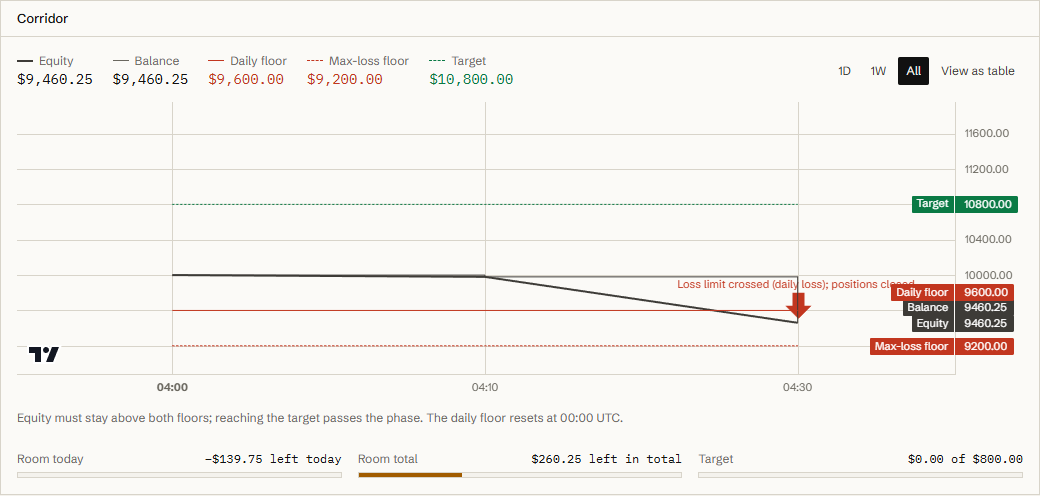
- Equity below the daily floor: the higher of balance and equity at 00:00 UTC, minus 4% of the starting balance. On 10K, a day that opens at $10,000 has its floor at $9,600.
- Equity below the max-loss floor: the starting balance minus 8%, fixed at $9,200 on 10K.
- A confirmed prohibited strategy, after a manual review.
Does not fail What does not
- A wick on one exchange. Breaches use a composite of Bybit and Hyperliquid marks; when they disagree, the account goes to review instead of failing.
- An exchange outage. Trading on that symbol pauses, and no breach is evaluated on a stale price.
- A payout. It is deducted from the balance and never counts as a loss.
- A losing day inside the limits. Only the floors fail an account.
05Payouts
Rewards every 14 days, in bitcoin.
- Your share
- 80%
- of simulated profit since the last payout
- First request
- after 14 days
- counted from the day the funded account starts
- Minimum
- $50
- your share, per request
- Cap per payout
- 5%
- of the starting balance ($500 on 10K)
- Lifetime cap
- $100,000
- per funded account
- Method
- Bitcoin
- on-chain, with the transaction link on your payout record
- 1Close your positions and request the payout from the dashboard.
- 2A reviewer checks the trades against the rules and the consistency limit of 40%.
- 3The reward is sent on-chain, with your evaluation fee refunded on the first one.
06Markets
Perpetuals on the largest crypto assets.
07FAQ
Questions traders ask first.
What am I buying?
A simulated evaluation account. You pay a one-time fee, trade crypto perpetuals in that account under the published rules, and if you pass you receive a simulated funded account. Rewards on the funded account are paid in bitcoin under the trader agreement. No real capital is traded and no order is sent to an exchange.
What is the difference between Classic 1-Step and 2-Step?
Classic 1-Step has one evaluation phase: a profit target of 8%, a daily loss limit of 4% and a max loss limit of 8%, plus a consistency rule.
2-Step has two phases, 8% then 5%, with wider limits (5% daily, 10% in total), no consistency rule in the evaluation, and a lower fee.
How do I pass?
All of these must hold at the same moment:
- profit reaches the target;
- you have traded on at least 3 separate UTC days;
- you have no open positions;
- equity never fell below either loss floor.
On Classic 1-Step your best day must also be at most 40% of your total profit. If it is larger, the target rises until it is not, and the dashboard shows that effective target.
What makes an account fail?
Equity below the daily floor or below the max-loss floor, at any moment, measured with the composite mark price. Equal is allowed; one cent below is a breach.
The daily floor is the higher of balance and equity at 00:00 UTC, minus 4% of the starting balance. On a Classic 1-Step 10K account that is $400 of room each day. The max-loss floor is the starting balance minus 8%, and it is static: measured from the starting balance, it never moves.
What can I trade?
BTC, ETH and SOL perpetual futures, quoted in USDT. Leverage is capped at 5x on BTC and ETH and 3x on SOL.
Which price decides a breach?
The composite mark price, built from the mark prices of Bybit and Hyperliquid. A spike on one exchange moves it by half at most, and when the two disagree by too much the symbol is marked degraded: a breach on a degraded symbol goes to review instead of failing the account. Every breach report stores the composite mark and each venue's price at that moment.
When and how are rewards paid?
On a funded account you can request a reward every 14 days, the first one 14 days after the account starts, with all positions closed. You receive 80% of the simulated profit. The minimum is $50, one payout is capped at 5% of the starting balance, and the lifetime cap is $100,000. Rewards are paid in bitcoin, on-chain.
Can I get a refund?
Yes, in full, until you place your first trade on the account. After the first trade the fee is not refundable. The refund policy has the details.